Reviewed · EVENING EXPERIENCES
Porto private night Tour, discover the most iconic attractions
Porto at night changes the whole city vibe fast. This private night tour is built for maximum seeing with less hassle, and it comes with onboard Wi-Fi plus a guide who makes the stories behind the landmarks make sense. I love how well it strings together neighborhoods and monuments in about 3 hours, but note that several big sights have entry fees not included.
If you want a first taste of Porto without spending your evening running between tickets, this is a smart move. You get pickup options in central Porto and Gaia, you ride comfortably in an executive vehicle, and you still get enough time at key photo stops to actually enjoy them, even when it is raining on and off.
In This Review
- Key takeaways before you go
- Private Night Format: How the 3 Hours Really Feels
- Praça da Liberdade to Avenida dos Aliados: Starting in the Right Light
- Mercado do Bolhão and Praça da Batalha: Local Daily Life, Night-Friendly
- Muralha Fernandina and the Cathedral Area: When Porto’s Walls Still Speak
- São Bento Station Tiles and Café Majestic: Two Stops That Make Night Feel Like Theatre
- Clérigos Tower and Livraria Lello: Views and Design Nerd Territory (In a Good Way)
- Churches, Hidden Spaces, and the Golden Interior of São Francisco
- Museums and Old-Tech Wonders: Electric Cars and Porto’s Science Buildings
- Palácio da Bolsa and the Douro Bridges: Big Architecture, Real Scale
- Jardim do Morro, Serra do Pilar, and the UNESCO View Circuit
- From Forts and the Sea to Serralves and Casa da Música
- Praça de Mouzinho de Albuquerque: A Monument Built for Scale
- Optional Add-Ons: Fado and Port Wine When You Want More
- Price and Value at $184.84 Per Person
- Should You Book This Porto Private Night Tour?
- FAQ
- How long is the Porto private night tour?
- What is included in the price?
- Are tickets to major attractions included?
- Is pickup offered?
- What time are the optional fado show sessions?
- What is the optional Dona Antónia Port wine cellar tour?
- Where does the tour start?
- What language is the tour offered in?
- What happens if the weather is poor?
Key takeaways before you go
- Private group feel with only your group participating, so the pace can suit you
- Onboard Wi-Fi plus bottled water and refreshments, which helps on a longer evening
- A guide-centered tour that focuses on history and practical context at each stop
- Photo-stop efficiency, including major viewpoints and signature architecture
- Mixed entry costs, with some attractions free and others requiring separate tickets
- Optional add-ons for fado and a Dona Antónia Port wine cellar experience if you want more
Private Night Format: How the 3 Hours Really Feels
This is a 3-hour private night tour in Porto, designed to hit a lot of iconic spots without the usual day-trip chaos. Because it is private, you are not stuck in a huge crowd flow. You also tend to get smoother logistics, especially if you are starting from a hotel or other central pickup point.
Your ride matters here. The tour uses luxury vehicles with extra equipment, and the onboard experience includes Wi-Fi, bottled water, and refreshments. That sounds like a nice perk, but at night it is practical too. You can check maps, look up what you just saw, and keep your phone charged while you are moving around.
The main drawback is what you might pay separately. Stops like Porto Cathedral, Clérigos Tower, Livraria Lello, São Francisco, and Palácio da Bolsa are specifically marked as not included. So this tour works best if you come with a flexible budget for a few ticketed highlights.
Other Porto plans worth comparing
- Porto: Bridges Cruise & Sunset & Port Wine Cellar Option
★ 4.2 · 4,180 reviews - Porto: Douro River Party Boat with Sunset Option & 6 Bridges
★ 4.7 · 2,040 reviews - Porto: Charming Sailboat Cruise with Port Wine,Sunset Option
★ 5.0 · 1,978 reviews
Praça da Liberdade to Avenida dos Aliados: Starting in the Right Light
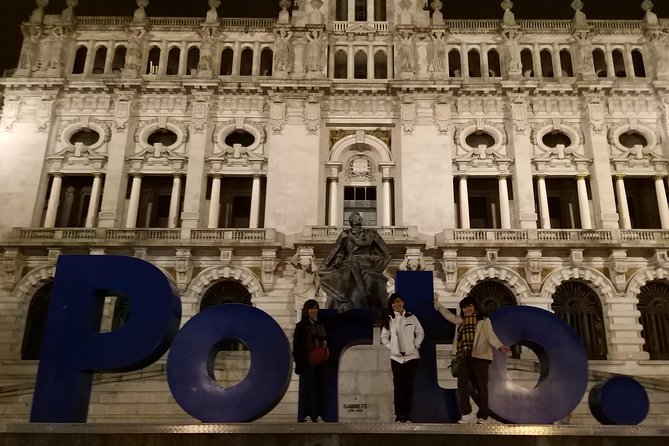
The tour begins at Praça da Liberdade, then works through the central core where Porto’s grandest streets show up. One of the early anchor moments is D. Pedro Square, right by Avenida dos Aliados, where the statue of D. Pedro IV (the Liberator) dominates the scene.
The setting is classic Porto “big city” style, with buildings from the 1920s and 1940s along a wide avenue. It is also a great first stop for orientation. You quickly learn where the civic center sits, and you can spot how the city’s major paths connect.
At night, this kind of start is useful because you see the scale of the main streets without daytime traffic. You get that immediate sense of where you are headed, and you can settle into the tour pace before the more architectural stops begin.
Mercado do Bolhão and Praça da Batalha: Local Daily Life, Night-Friendly
Mercado do Bolhão is one of Porto’s most emblematic markets, dating to 1850 and known for its neoclassical two-floor structure. What makes it special is that it still feels like a working market, not a museum. The fresh-product focus is split into specialized sections like fish, butchers, vegetables, and floral items.
Even with a short stop, markets are a quick way to get a feel for Porto’s rhythm. At night, the market itself can be less about shopping and more about atmosphere, architecture, and getting your bearings in the historic center.
Then you shift to Praça da Batalha, a square tied to a battle narrative from around the 10th century, plus later urban development in the 1800s. It is a reminder that Porto’s story is not just about riverside beauty, but also about conflict, rebuilding, and civic life. The area also features Teatro São João, inaugurated in 1798, and tragically destroyed in a 1908 fire.
Muralha Fernandina and the Cathedral Area: When Porto’s Walls Still Speak
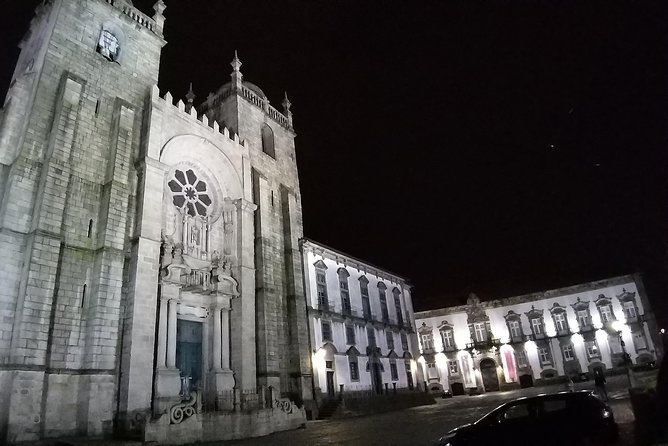
Muralha Fernandina is one of those stops that makes history feel physical. This defensive wall began in the 14th century to replace an older fortification and respond to the city’s expansion. It was almost completed around 1370, with completion tied to later reigns in the late 1300s to early 1400s.
At night, walls like this do a good job of changing your perspective. You start thinking about Porto not as one postcard, but as a city that had to defend itself, then grew around those boundaries.
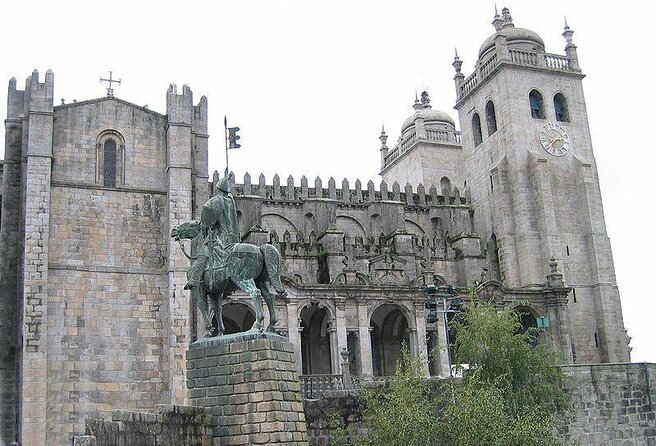
Next up is Catedral do Porto, dating to the 12th and 13th centuries, with expansions and renovations over time. What you’ll want to look for are the Gothic elements and special chapels, including the Gothic Chapel of St. John the Evangelist and cloister. The cathedral also highlights a silver altar in the Chapel of the Blessed Sacrament. This stop is ticketed (not included), so decide in advance if you want to spend your evening money on it.
In the same part of Portugal:
- The Unvanquished Tour in Porto City Center
★ 5.0 · 26,497 reviews - From Porto: Douro Valley w/ Boat Tour, Wine Tasting & Lunch
★ 4.7 · 19,061 reviews - Complete Douro Valley Wine Tour with Lunch, Wine Tastings and River Cruise
★ 5.0 · 12,920 reviews - Porto: Six Bridges Cruise
★ 4.2 · 11,680 reviews
São Bento Station Tiles and Café Majestic: Two Stops That Make Night Feel Like Theatre
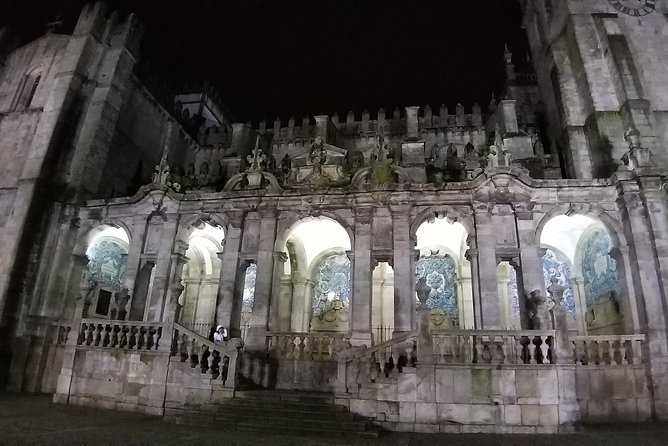
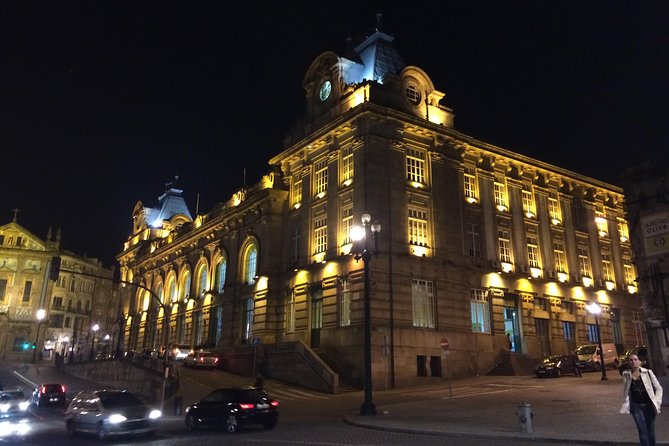
São Bento Railway Station is a must for most Porto first-timers, and it is almost impossible to miss once you are there. The station’s early 20th-century architecture sits where a 16th-century convent used to stand. You walk into a vestibule covered in 20,000 painted tiles by Jorge Colaço, showing scenes tied to Portugal’s regional history and everyday life.
This is the kind of stop that rewards even a short visit. You can stand back, then walk closer to pick out different scenes in the tilework. It is free, and it sets a strong tone for the rest of the evening.
A few streets away, Café Majestic brings Porto’s Belle Époque glamour into the mix. Opened in 1921, it is a standout Art Nouveau interior with marble, gilded mirrors, and intricate woodwork. It is not just a pretty room either. It is a long-time meeting place for intellectuals and artists, and it is still easy to grab a pastry or coffee while soaking up the atmosphere.
Right near Café Majestic is Relógio das Galerias Palladium, an ornate clock with statues that perform every three hours. It is a great night add-on if you are timing your stops well, because you catch a moving slice of Porto’s public art.
Clérigos Tower and Livraria Lello: Views and Design Nerd Territory (In a Good Way)
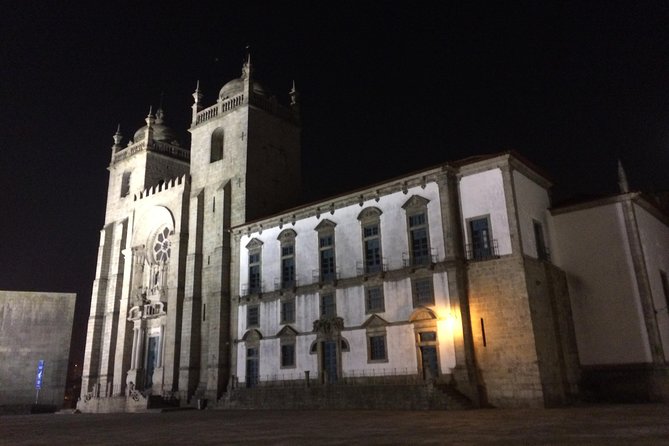
Clérigos Tower is one of Porto’s most iconic monuments, a Baroque work designed by Nicolau Nasoni and built in the early 1700s. The payoff is simple: 240 steps up for panoramic views over Porto and the Douro River. This stop is ticketed (not included), but the location and sightline make it one of the most “worth it” decisions on the route.
If you like architecture trivia, the tower also appeared in the 2021 Hollywood blockbuster Suicide Squad. Even if you are not a movie person, that fact tells you the tower has a strong visual identity from far away.
Livraria Lello is the other design-focused headline stop. The bookstore building opened in 1906 and features an Art Nouveau façade with Neo-Gothic details. Inside, you’ll find painted plaster work imitating wood and a famous staircase connected to an upper floor, with construction noted as among the first works of reinforced concrete in Porto. There is also a large stained-glass skylight with the monogram and motto of the library.
Livraria Lello is ticketed (not included). If you are the type who likes to savor interiors rather than just snap exterior photos, this is a good one to prioritize.
Churches, Hidden Spaces, and the Golden Interior of São Francisco
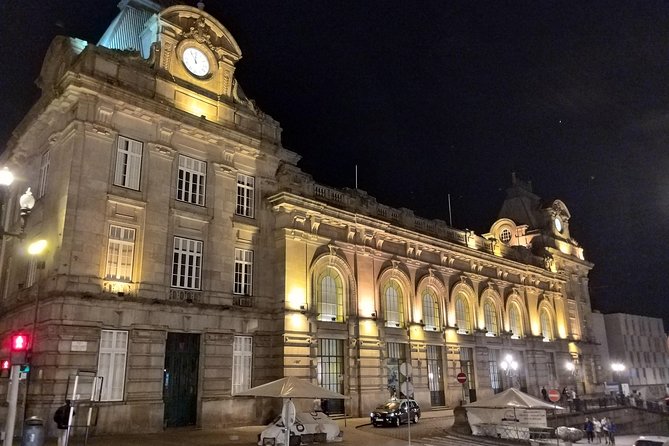
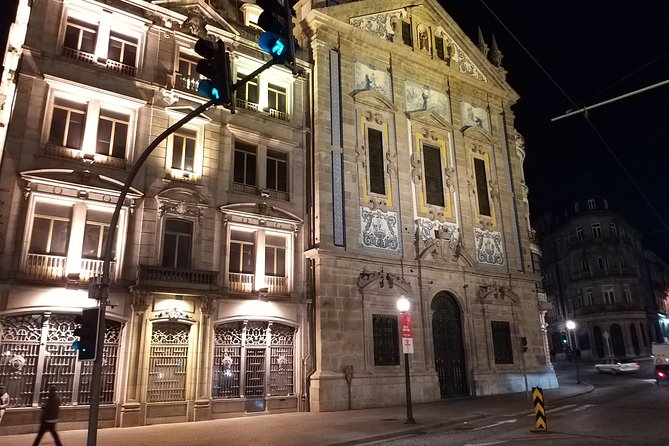
Porto’s church stops feel extra meaningful on a night tour because lighting makes stonework and tilework more dramatic. Igreja do Carmo and Igreja das Carmelitas are both Baroque landmarks, and the exterior of Igreja do Carmo is known for azulejos, painted ceramic tiles. They sit close enough that you can see the contrast between the two churches in a single short window.
Between them is something you might not notice on your own: Casa Escondida, the Hidden House. It is a small house wedged between the two churches, a clever architectural solution for a tight urban spot. Even with a quick look, it is a reminder that Porto’s built environment is dense and inventive.
Then comes Igreja de São Francisco, the most important Gothic temple of the city, with construction begun in the 14th century. The reason people talk about it is the famous golden interior from the 17th and 18th centuries, plus details like the Tree of Jesse and access to catacombs. This one is ticketed (not included), but it is positioned as a major highlight, so if you only add tickets to a couple of stops, this is a strong contender.
Museums and Old-Tech Wonders: Electric Cars and Porto’s Science Buildings
Not every night tour gives you variety beyond churches and streets. Here you get a couple of practical, different-minded cultural stops.
One is the Electric Car Museum, inaugurated in 1992 and housed in the former Massarelos central. It holds trams and other auxiliary vehicles used in Porto, plus an American horse-drawn trolley bus introduced to Porto in 1872. It also includes examples of original equipment previously used there. This is ticketed status not clearly listed, so plan for the possibility that it may require admission.
You also pass by the Museum of Transport and Communications, in a 19th-century neoclassical building built by engineer Jean F. G. Colson. It has two façades, one facing the Douro River and the other facing the city. The building is interesting partly because of its construction approach, including iron used alongside other materials depending on the space functions. It opened in 1992, and it fits the theme of Porto as a city shaped by transport and trade.
If you enjoy learning with your feet on the ground, these stops help balance the more famous postcard sites.
Palácio da Bolsa and the Douro Bridges: Big Architecture, Real Scale
Palácio da Bolsa is one of the most visited monuments in Porto, classified as a National Monument and designed in a neoclassical style in 1842. It is connected to the Commercial Association of Porto, and it was built on the site of a former convent destroyed during the Siege of Porto. The highlight is the famous Arab Room, though it is ticketed (not included).
Even if you skip interior tickets, the exterior and location make sense in the night flow. It is positioned at the edge of the historic center and connected to the city’s trade story, so it feels like a natural bridge between cultural landmarks and Porto’s working identity.
Then you move into bridge country. Porto’s Douro crossings are not just structures, they are how the city stitches together viewpoints, neighborhoods, and UNESCO-listed areas. You’ll hear about the suspension bridge D. Maria III, inaugurated in 1843 but deactivated after a few years due to insecurity fears, with only two stone pillars remaining today.
You also pass the São João Bridge described as a replacement for the D. Luís I bridge top, built to carry a metro line. The deck is 371 meters long and 20 meters wide, using a Maillart-type arch design with a span-arrow ratio highlighted as a world record for this typology.
And you finish this bridge story with Ponte D. Maria Pia, Gustave Eiffel’s first masterpiece, inaugurated in Porto in 1877 and used for 114 years until São João Bridge replaced it. The metal arch and single-track rail setup are part of the iconic look people associate with Eiffel’s early engineering work. Ponte D. Maria Pia is free to view from outside, which helps on a time-limited night.
Jardim do Morro, Serra do Pilar, and the UNESCO View Circuit
After all the architecture, you get a breather with a classic viewpoint stop: Jardim do Morro. This public park gives panoramic views and it is popular with both locals and visitors. It is also a calm transition from the dense streets into open-air night air.
Next is Mosteiro da Serra do Pilar in Vila Nova de Gaia, on an elevation called Serra do Pilar along the Douro River. The monastery belongs to the Order of St. Augustine, construction began in 1538, and the church and cloister use circular shapes that make the building feel distinctive. It is classified as a National Monument and, together with Porto’s historic center and the Luís I Bridge, part of the UNESCO World Heritage listing.
This cluster works well at night because the viewpoints are the reward. You see why people fall for Porto and why the Douro River is more than a scenic line on a map.
From Forts and the Sea to Serralves and Casa da Música
The route keeps pushing outward across different Porto moods.
You’ll see modern bridge work on the Arrábida Bridge, designed by Edgar Cardoso, inaugurated in 1963. It was once described as the longest reinforced concrete bridge in the world and sits about 70 meters above average water level. There are bronze sculptures on top of large support pillars, giving a modern, sculptural edge to what is still a serious piece of engineering.
Then the coastal defensive story shows up with Fortress Sao João Baptista, built at the end of the 16th century to protect the coast and the Douro entrance. Later fortifications in the 17th century and an 18th-century access gate add layers. Close by is Castelo do Queijo, the São Francisco Xavier Fort built in the 17th century to fend off pirates of North Africa. It sits on a rocky hill shaped like cheese, hence the name. Both forts are ticketed (not included).
Porto’s public art also gets a moment with She Changes, also known as Anemone. It is a sculpture by Janet Echelman made from a fishing net that moves with the wind, looking like a huge anemone responding to sea currents. Even if you are not an art person, this is a memorable night effect.
Next, Leixões Port enters the picture, with cruise activity boosted by a new cruise pier opening in April 2011. If you want a glimpse of Porto as a living port city, this stop provides that reality check.
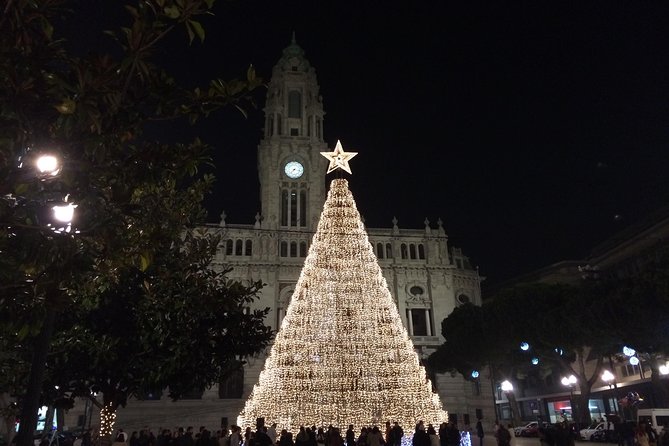
Finally, the tour reaches the Serralves area, known for the Serralves Park and the Art Deco House built in the 1930s. Serralves brings together the Museum of Contemporary Art, the Art Deco House, and the park, plus leisure facilities, shops, and a restaurant. You also reach Casa da Música, Porto’s main concert hall in the Boavista area, designed by Rem Koolhaas and inaugurated in 2005.
Praça de Mouzinho de Albuquerque: A Monument Built for Scale
You end at Praça de Mouzinho de Albuquerque, where you get a big visual payoff: a monument with a 45 meter high statue. It commemorates the Heroes of the Peninsular War and includes an obelisk and sculpture groups showing the union of Portuguese and English forces against French Napoleonic armies.
The monument includes the lion for the English connection and an eagle for the victory theme. It is the kind of stop that sticks because it is too large to forget, and it brings your night tour into a civic, historic frame beyond individual buildings.
Optional Add-Ons: Fado and Port Wine When You Want More
If you still have energy after the 3 hours, there are two popular options.
Fado show in Porto with Port Wine is offered at 18:00 and 19:30 daily, lasting 1 hour. It is priced between €20 and €26 per person and includes Port wine tasting. Importantly, it is not included in the base tour price, and the tour starts 2 hours earlier if you add this.
The exclusive Dona Antónia Port Wine Cellars tour costs €32 to €41 per person for 1h30 and includes tasting of five Port wines. It focuses on Dona Antónia Adelaide Ferreira, described as the visionary woman who shaped the destiny of Port wine and the Douro region. Like fado, it is not included in the base price, and your tour would start 2 hours earlier.
Price and Value at $184.84 Per Person
At $184.84 per person for about 3 hours, this is not a budget group tour. The value is in the private format, the executive vehicle, and the fact that you are getting a lot of iconic sights with practical context rather than just being dropped at stops.
What you are paying for:
- pickup options in central Porto and Gaia
- transport in luxury vehicles
- onboard Wi-Fi plus bottled water and refreshments
- personal accident and liability insurance
- a guide who ties together history and what you are actually looking at
What could change the total cost for you:
several major interiors and towers are marked as not included, including Porto Cathedral, Clérigos Tower, Livraria Lello, Igreja de São Francisco, and Palácio da Bolsa, plus some forts. If you are planning to visit those, budget extra. If you are happy with exterior viewing for a couple of them, the base price can feel more balanced.
One more value point: it is scheduled for good weather, and if weather cancels, you are offered a different date or a full refund. That matters when you are trying to plan a smooth evening.
Should You Book This Porto Private Night Tour?
Book it if you:
- want a fast, guided introduction to Porto’s most iconic sights after dark
- appreciate history that explains what you are seeing at street level
- like the idea of Wi-Fi, refreshments, and pickup so your evening stays easy
Skip or adjust expectations if you:
- want a strictly ticket-included itinerary, because several stops are not included
- prefer long museum time at a single site, since this route is built for many short stops and photo moments
If you want one practical upgrade: plan which ticketed interiors are your top two, then use the rest of the tour for architecture, viewpoints, and street-level atmosphere. That way, the $184.84 feels like money spent on guidance and logistics, not just access.
FAQ
How long is the Porto private night tour?
It lasts about 3 hours.
What is included in the price?
The tour includes transport in luxury vehicles, onboard Wi-Fi, bottled water and refreshments, personal accident and liability insurance, and the private guided experience. Fado and Port wine cellar tours are not included.
Are tickets to major attractions included?
No. Several stops are marked as admission not included, including Porto Cathedral, Clérigos Tower, Livraria Lello, Igreja de São Francisco, Palácio da Bolsa, and multiple forts.
Is pickup offered?
Yes, pickup is offered to downtown hotels and B&Bs in Porto and Gaia.
What time are the optional fado show sessions?
Fado shows are scheduled daily at 18:00 and 19:30. The add-on includes Port wine tasting.
What is the optional Dona Antónia Port wine cellar tour?
It is a 1h30 tour with tasting of five Port wines. It is priced at €32 to €41 per person and is not included in the base tour.
Where does the tour start?
The meeting point is Praça da Liberdade 19, 4000-322 Porto, Portugal, and the tour ends back at the meeting point.
What language is the tour offered in?
It is offered in English.
What happens if the weather is poor?
This experience requires good weather. If it is canceled due to poor weather, you are offered a different date or a full refund. Free cancellation is available if you cancel at least 24 hours in advance.
Just added around Porto
- Meditation Experience at a Lovely Farm in Porto★ 5.0 · 19 reviews
- Private Portuguese Cooking and Wine Experience in Porto★ 5.0 · 30 reviews
- Douro Valley Prime Tour: Wine Tastings, Boat & Lunch from Porto★ 5.0 · 572 reviews
- Port Wine Tour | 3 Cellars | 7 Tastings | 12 Participants Maximum★ 5.0 · 443 reviews
- Private Boat Tour on the Douro River at Sunset★ 5.0 · 21 reviews
- Visit to Cockburn’s Cellars★ 5.0 · 526 reviews
- Wine Tasting with Tapas Walking Tour in Porto★ 4.5 · 544 reviews
- PORTO city Walking Tour★ 5.0 · 132 reviews
Evening Experiences, compared.
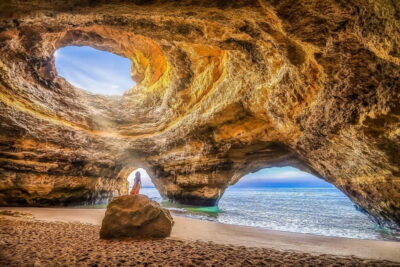
Benagil Caves Speed Boat Tour with Sunset Option
Read our review →
Sunset Boat Party Cruise with DJ and Open Bar
Read our review →
Bridges Cruise & Sunset & Port Wine Cellar Option
Read our review →
Daytime/Sunset/Night City Sailboat Tour with Drink
Read our review →
Sunset Catamaran Boat Tour with Music and Drinks
Read our review →