
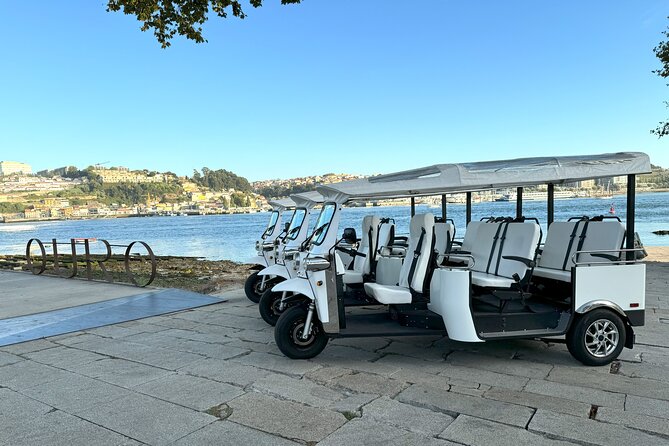
Reviewed · TUK TUK CITY TOURS
Cruise Shore Excursion – Private Tuk Tuk Tour to the Historic Center
Porto is best when you avoid uphill walking. This private tuk tuk tour strings together the city’s big-name monuments, plus smart viewpoints over the Douro, with a guide giving the stories behind it all. You even get a port wine taste during the ride.
I especially like how you get a fast, organized orientation to Porto’s layout, including river viewpoints like Passeio das Virtudes, without feeling like you’re rushing nonstop. Another win is the comfort factor, since the tuk tuk helps you cover steep, hilly streets that can grind down a cruise-day schedule.
One thing to watch for is that some famous stops require paid monument entrance (like Torre dos Clérigos and Livraria Lello), so the tour still needs a little ticket planning on your part.
In This Review
- Quick hits
- Why a private tuk tuk is the smart Porto move on a cruise day
- Pickup timing and how 3.5 hours usually plays out
- Early heritage stops: seafaring sculpture, a granite tower, and a themed garden intro
- Passeio das Virtudes viewpoints, the Douro mouth bar, and where to pause
- Portuguese Centre for Photography, Cordoaria Garden, and the city’s layered design
- Torre dos Clérigos and Livraria Lello: famous stops, short time windows
- Rococo churches and the Fonte dos Leões details you’ll want to spot
- Squares, Palácio da Bolsa, and Ribeira as the nightlife heartbeat
- D. Luís I Bridge iron decks, Serra do Pilar terrace views, and crossing the river story
- Batalha square, the São João National Theatre area, and tile-chapel flourishes
- Bolhão Market and the reality of refurbishment
- Price and value: what $106.93 really buys you
- Who should book this tuk tuk Porto tour
- Should you book this private tuk tuk Porto shore excursion?
- FAQ
- How long is the private tuk tuk tour to Porto’s historic center?
- What is the price per person?
- What is included in the tour?
- Are monument entrances included?
- Is pickup offered for cruise passengers?
- What time does the tour usually operate?
- Is the tour offered in English?
- What is the cancellation and weather policy?
Quick hits
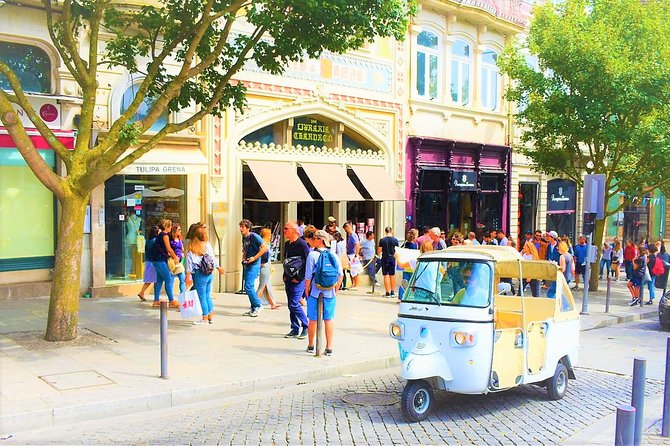
- Private tuk tuk with cruise-area pickup from Leixões Port, Matosinhos Port, or Doca Norte
- Douro viewpoint time at Passeio das Virtudes, plus bridge views from Serra do Pilar
- Port wine glass included, usually served at a lookout stop, not a full bar stop
- Major Porto highlights in one sweep: Clérigos Tower area, Livraria Lello area, Ribeira, and more
- Some interiors are not included, so expect to buy separate tickets if you want to go in
Why a private tuk tuk is the smart Porto move on a cruise day
Porto is gorgeous, but it is also steep. A tuk tuk is made for this kind of city, letting you glide between viewpoints and historic streets without turning your day into a stair workout.
What makes this tour work well is the mix of sights and explanation. You are not just seeing postcard exteriors, you are getting the why behind them, from seafaring and industrial heritage to how Porto’s churches and gardens became cultural landmarks.
You also get the benefit of a guide who can steer your time. Since each stop is limited, you want someone who helps you decide what to prioritize, and this tour format is built around that.
More Boat Tours in Porto
- From Porto: Douro Valley w/ Boat Tour, Wine Tasting & Lunch
★ 4.7 · 19,061 reviews - Complete Douro Valley Wine Tour with Lunch, Wine Tastings and River Cruise
★ 5.0 · 12,920 reviews - Porto: Six Bridges Cruise
★ 4.2 · 11,680 reviews
Pickup timing and how 3.5 hours usually plays out
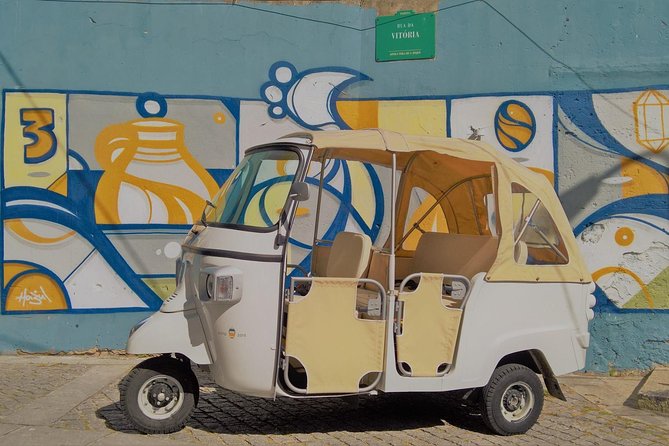
This is roughly a 3.5-hour experience, and it is designed around cruise logistics. Pickup is offered from specific points, including the main gate at Leixões Port, Matosinhos Port, and Doca Norte, and the tour starts no later than 1 hour after your ship arrives.
Open hours run from 8:00 AM to 11:00 AM, Monday through Sunday. If you want the most relaxed pace, I’d aim for an early morning start, since you’ll typically hit viewpoints before crowds build and before your ship-day energy drops.
Also note what you do not want: a long, awkward waiting gap at the pier. Several guides are praised for being on time, and some travelers specifically call out that communication and timing matter a lot, so I suggest you double-check your exact pickup point and timing once you have confirmation.
Early heritage stops: seafaring sculpture, a granite tower, and a themed garden intro
The tour often begins with a stop that frames Porto’s maritime and industrial story. You’ll see a sculpture concept designed to reflect both Porto and Matosinhos seafaring heritage, with support poles painted to resemble smokestacks and lighthouses, and a net structure referencing the fishing industry. It’s a nice first “story anchor” before you get into the classic center.
Next comes a granite tower described as hexagonal and about 10 meters high, with a red balcony and lantern, plus a small annex with white plastered walls. It’s the kind of detail you might miss if you were self-guiding, and it gives you quick visual context for Porto’s mix of styles.
Then you move into a 19th-century garden area with lots of character. Expect architectural features tied to older sites, including a granite fountain to the west from the former S. Francisco Convent, two Nasoni obelisks from Quinta da Prelada, and a small romantic chalet built in 1874 before the completion of the garden. There are also practical highlights like a miniature golf course and philharmonic concerts that sometimes happen at the bandstand.
One small consideration: garden time is usually short in a half-day tour. You can enjoy the garden’s details, but if you love horticulture or want to linger, you may want to save extra time for a return visit later.
Passeio das Virtudes viewpoints, the Douro mouth bar, and where to pause
Passeio das Virtudes is a key stop because it shows Porto’s river relationship in one glance. From the lane, you get an excellent view down toward the Douro mouth bar, plus the Fountain of Virtudes and the terraces dropping toward São Pedro de Miragaia.
This is also where you’ll spot big-city landmarks like the imposing former Customs House building along the river. The guide’s job here is important, because “just looking” is nice, but understanding what you’re seeing makes it memorable.
You’ll likely have a moment to absorb the view, and this is also the kind of stop where the timing tends to feel right for cruise travelers. In at least one experience, the port wine portion was served during this kind of viewpoint pause, in a small tasting cup, which means it feels like a moment in the scenery rather than a separate detour to a bar.
More Tuk Tuk Tours in Porto
- Porto: Guided Tour by Tuk-Tuk & Optional Douro River Cruise
★ 4.5 · 5,980 reviews - Discover Porto’s Highlights on a 2-Hour Private Electric Tuk Tuk
★ 4.5 · 1,860 reviews - Porto: Guided Tuk Tuk Tour
★ 4.6 · 1,390 reviews - Historic Porto by Private Electric Tuk Tuk to Top Landmarks
★ 4.5 · 735 reviews
Portuguese Centre for Photography, Cordoaria Garden, and the city’s layered design
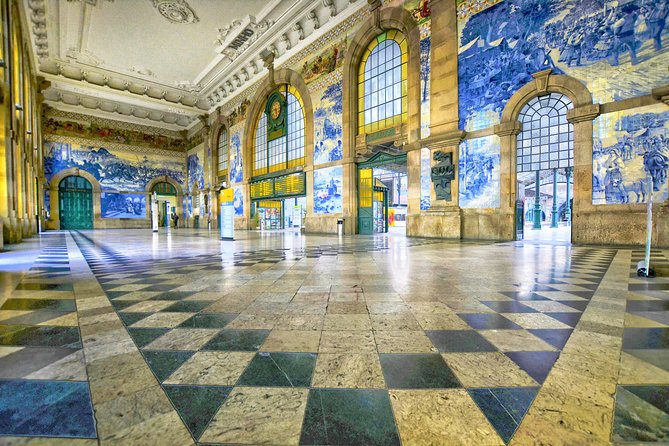
You’ll then get a taste of Porto’s creativity and preservation through the former polygonal granite building now used as the Portuguese Centre for Photography. The building dates to 1582 and was rebuilt in 1767 in a neo-classical style, with a geometric rhythm of 103 windows. It also has a fascinating past, including detentions connected to Camilo Castelo Branco and Zé do Telhado, before it became a cultural space.
Next, Cordoaria Garden, also called Jardim de João Chagas, helps connect the dots between industry and leisure. The garden is tied to rope makers who worked in the area for roughly 200 years, and the project is credited to the German landscaper Emile David around 1865 to 1866. You’ll see statues such as those of Ramalho Ortigão and António Nobre, plus sculptures by Juan Muñoz from 2001.
This section is valuable because it breaks the tour away from only “big monuments.” Porto is not just towers and tiles. It’s also how old industry spaces and older structures get repurposed into places you can walk, rest, and look up at.
Torre dos Clérigos and Livraria Lello: famous stops, short time windows
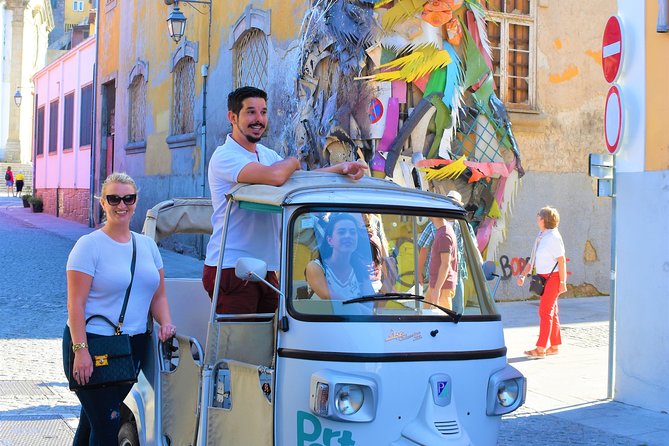
Torre dos Clérigos is one of the city’s iconic landmarks, and the payoff is real. The baroque tower is from the first half of the 18th century, and the top view is reached by a 240-step climb. The experience is also designed with a multi-sensory setup that simulates the climbing element for those who cannot or prefer not to do all steps.
Keep expectations practical: admission is not included, so you need tickets if you want inside access. That’s not a dealbreaker, but for cruise days, it means you should think before you arrive, so you don’t lose time deciding on the fly.
Then it’s Livraria Lello, the famous Art Nouveau library. The exterior is known for its Art Nouveau façade with neo-Gothic details, and inside you’ll find painted plaster mimicking wood plus a striking stained-glass skylight with the library monogram and motto, Decus in Labore. A standout feature is its grand staircase, one of the early reinforced concrete works in Porto.
Here’s the practical tip: the regular ticket lines can get long. One traveler specifically notes that you should buy skip-the-line tickets online if you want to get inside during a short tour window. If you don’t, you might enjoy the exterior and the area vibe without fully experiencing the interior.
If you hate lines or time pressure, still go. Just have a plan. These are two of the most photo-worthy places on the route, and the surrounding streets are part of the story too.
Rococo churches and the Fonte dos Leões details you’ll want to spot
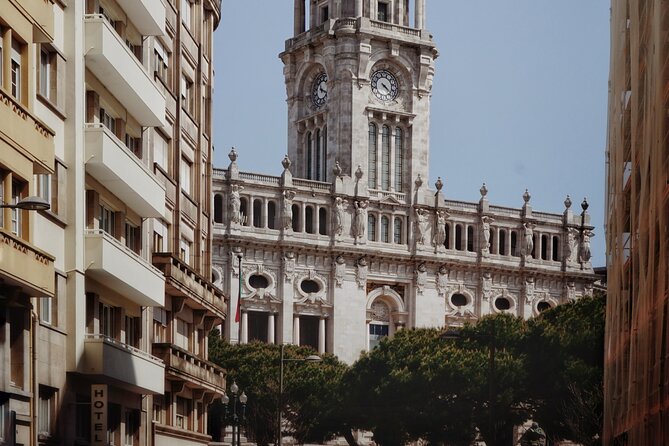
Between the famous towers and bookshop area, you get a mix of church stops and a simple but memorable fountain.
Fonte dos Leões is a 19th-century fountain built by a French water company and cast in France. It is also a copy, in most part, of the fountain in Leicester’s Town Hall Square in England. It’s a fun example of how ideas travel, and it’s the kind of detail a guide can point out fast.
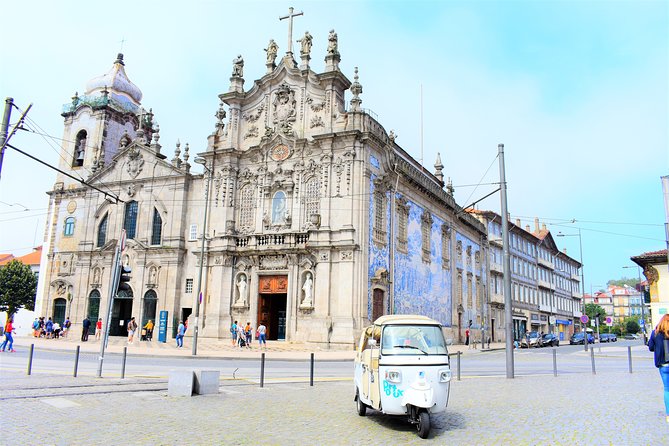
Igreja do Carmo is a rococo highlight with tiles on its lateral façade, covered in 1912. The tile drawings were designed by Silvestre Silvestri and are figurative compositions tied to the cult of Nossa Senhora, Our Lady. This is designated a national monument, and admission is not included.
Igreja dos Carmelitas, a 17th-century church with a classical façade, is another national monument. Its façade dates to the 1850s, and the project has been attributed to Nicolau Nasoni. The altarpiece is described as Porto rococo and was seen as stylistically revolutionary.
You’ll feel a pattern here: Porto’s religious architecture is not quiet and plain. It’s theatrical. Even on a time-limited tour, these stops help you see why the city gained a reputation for artistic intensity.
Squares, Palácio da Bolsa, and Ribeira as the nightlife heartbeat
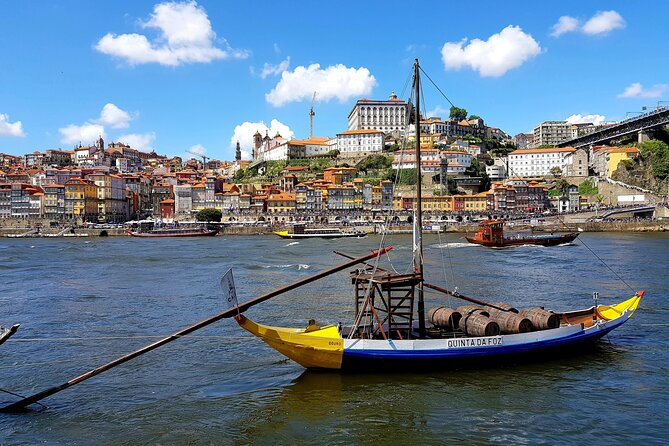
In the historical center you pass by spaces that anchor Porto’s public life. One important area is the setting for the Infante D. Henrique Monument, inaugurated as part of the 5th centenary of his death, celebrating Portuguese navigation and faith.
Nearby is Palácio da Bolsa, the Stock Exchange Palace. Designed in 1842 in neoclassical style, it’s tied to the Commercial Association of Porto and is famous for the Arabian Room. Since monument entrances are not included, you’ll likely focus on the exterior and the approach unless you add your own ticket.
You also visit Mercado Ferreira Borges. Built in 1885 and tied to iron architecture in Porto, it has been renovated into an entertainment venue, with Hard Club now located there. Again, your time here is likely a quick look, not a deep inside visit, since access details fall under monument entry rules.
Then you reach Praça da Ribeira, one of the oldest squares in the city, and it’s a highlight for atmosphere. It’s described as a busy commercial center with fish market tents, and it became a major focus for 18th-century remodeling financed by revenue from wine. You’ll hear about a reconstructed 17th-century fountain and a sculpture nicknamed the Cube of Ribeira, plus a St John the Baptist statue unveiled in 2000.
Important practical note: this place is closed to vehicles, which is good for pedestrians but can make car traffic impossible to enter directly. The guide’s navigation skill helps here, and the tuk tuk route timing matters.
D. Luís I Bridge iron decks, Serra do Pilar terrace views, and crossing the river story
Porto’s bridges feel like part of the city center. You’ll see D. Luís I Bridge, the 1886 iron structure designed by Teófilo Seyrig, a disciple of Eiffel. It has two overlapping iron decks, and today the upper deck connects via the Metro to areas toward Vila Nova de Gaia, including links toward Porto Cathedral and the Garden of Morro.
Then you get to Mosteiro da Serra do Pilar, a UNESCO World Cultural Heritage site with a circular church plan. Construction started in 1538 and finished around 1670. The cloister is circular too and has 36 Ionic columns, noted as the only example in Portugal.
This stop is valuable because the terrace views are the whole point. From there, you can see the riverside area across Porto and Gaia, including the historic center with emphasis on the Cathedral and D. Luís I bridge, and you can also look toward Fontainhas and the São João bridge. It is the kind of viewpoint where a guide’s narration turns geography into a story.
You may also spot bridge architecture details in the background. The tour includes a description of the Arrábida Bridge, a reinforced concrete arch bridge carrying traffic over the Douro, concluded in 1963, engineered by Edgar Cardoso, and at the time the largest concrete-arch bridge in the world by main span. You’ll also hear about another major bridge inaugurated in 2003 with a Maillart-type arch design and a world record arch span, connecting Fontainhas to Oliveira do Douro in Vila Nova de Gaia.
You do not need to memorize engineering specs to enjoy the stop. The real value is learning that Porto’s identity is not only in buildings, but in bridges and how the city moves people across water.
Batalha square, the São João National Theatre area, and tile-chapel flourishes
The tour then works its way into squares and cultural landmarks that feel distinct from the Ribeira nightlife zone.
Praca da Batalha is dominated by a monument to D. Pedro V and is surrounded by major historic buildings, including the São João National Theatre and Cine-Teatro Batalha. It’s a classic “big square” moment where you see civic planning and theater life side by side.
Nearby is the São João National Theatre building, constructed in 1910 on ruins of the Real Theatre, which burned down in 1908. The architecture includes stylistic emblems tied to pain, quality, hate, and love, and it drew inspiration from Luís XVI style associated with the early 20th century. The building was designed by Marques da Silva.
You may also stop at a chapel built in the early 18th century, with Our Lady of the Souls inside. In 1929, the exterior received tile coverage with scenes from the life of St Francis of Assisi and St Catherine, and those panels were recovered in 1982.
This final stretch is great for travelers who like art on surfaces. Tiles, façades, and theatrical buildings are Porto’s secret language. Even if you only do quick looks at each spot, you’ll leave with a sharper eye for what to notice next.
Bolhão Market and the reality of refurbishment
Bolhão Market is listed as the city’s most famous market, with a history dating back to 1850 and a neoclassical structure over two floors. The design includes shops opening to surrounding roads, and the market is mainly fresh products, with fishmongers, butchers, green grocers, and florists.
However, it is currently closed for refurbishment works. So treat it as a “see what you can from the outside” moment unless your specific day offers different access than the stated status.
That said, the surrounding area is still useful for planning your own free time. After a tour like this, I always use the last segment to decide where I want to return on foot later, especially around markets and squares where you can eat casually.
Price and value: what $106.93 really buys you
At $106.93 per person, the best way to judge value is to compare what you get in a cruise day time window.
You’re paying for a private tuk tuk experience with a driver/guide, live commentary on board, a local guide, and a included glass of port wine. You’re also paying for coverage of major highlights across neighborhoods, including viewpoints, churches, and iconic Porto landmarks that would take longer and more effort by bus or by foot.
The main “cost you control” is monument entrances. Torre dos Clérigos and Livraria Lello are explicitly not included, and several other churches and major interiors also fall under this same rule. If you want to go inside multiple places, budget for additional tickets, and plan your priorities before the tour starts.
So is it worth it? For a first-time Porto visit with limited time, I think it often is. You get a strong orientation plus a guided path through the steep parts that can wear you out fast.
But if you hate paying extra for interiors, or if you only care about one or two sites, you might prefer a less expensive option that focuses on a smaller area.
Who should book this tuk tuk Porto tour
This one fits best if you:
- want a big highlights overview in a short time
- like guided context, not just photos
- have limited mobility or tired legs and want fewer hills
- want to sample port wine without turning it into a whole separate outing
It may be a less ideal match if you:
- expect plenty of shopping time at each stop
- are sensitive to bumpy cobblestones
- have a larger group, since one traveler notes the tuk tuk can feel uncomfortable for 3 people and that it is built for 2
If you care about “private” being truly private, I’d still confirm details with the provider before you go. One reviewer reports a situation where a private booking ended up sharing the tuk tuk due to overbooking, so it’s worth double-checking expectations.
Should you book this private tuk tuk Porto shore excursion?
If your priority is a smooth, guided highlights circuit that avoids steep walking, I’d book it. The combination of tuk tuk access, strong city orientation, and river viewpoints like Passeio das Virtudes and Mosteiro da Serra do Pilar makes it a smart use of cruise time.
Just go in with two practical expectations: plan for paid entrances if you want interiors, and accept that the tour is designed for sightseeing over long shopping breaks. If that matches your style, you’ll likely come away with Porto feeling clear, connected, and easier to explore later on your own.
FAQ
How long is the private tuk tuk tour to Porto’s historic center?
It runs for about 3 hours 30 minutes.
What is the price per person?
The price is $106.93 per person.
What is included in the tour?
It includes a driver/guide, live commentary on board, a local guide, and an alcoholic port wine glass.
Are monument entrances included?
No. Monument entrance fees are not included.
Is pickup offered for cruise passengers?
Yes. Pickup is offered from the main gate at Leixões Port, Matosinhos Port, and Doca Norte.
What time does the tour usually operate?
Tours run between 8:00 AM and 11:00 AM, Monday through Sunday.
Is the tour offered in English?
Yes, it is offered in English.
What is the cancellation and weather policy?
You can cancel for a full refund up to 24 hours in advance. If the experience is canceled due to poor weather, you’ll be offered a different date or a full refund.
More Cruises & Boat Tours in Porto
- Porto: Douro Valley with Winery Lunch, Tastings & Cruise
★ 4.7 · 7,002 reviews - Porto: 6 Bridges Douro River Cruise
★ 4.3 · 6,472 reviews - From Porto: 2 Wine Regions, Farm-to-Table Lunch & Boat
★ 4.9 · 5,724 reviews - Douro Valley: Historical Sites, Wine Experience, Lunch & Cruise
★ 5.0 · 5,133 reviews
Tuk Tuk Rides in Porto
- Porto Guided Tour to the Historical Center on a Tuk Tuk
★ 4.5 · 418 reviews - Porto: Private Sightseeing Tour by Electric Tuk Tuk
★ 4.8 · 305 reviews - Oporto Tuk-Tuk Tour: Fast, Fun & Flexible – 1H to Full Day!
★ 4.7 · 280 reviews - Porto Half Day Private Tuk Tuk Tour
★ 4.5 · 246 reviews
Just added around Porto
- Meditation Experience at a Lovely Farm in Porto★ 5.0 · 19 reviews
- Private Portuguese Cooking and Wine Experience in Porto★ 5.0 · 30 reviews
- Douro Valley Prime Tour: Wine Tastings, Boat & Lunch from Porto★ 5.0 · 572 reviews
- Port Wine Tour | 3 Cellars | 7 Tastings | 12 Participants Maximum★ 5.0 · 443 reviews
- Private Boat Tour on the Douro River at Sunset★ 5.0 · 21 reviews
- Visit to Cockburn’s Cellars★ 5.0 · 526 reviews
- Wine Tasting with Tapas Walking Tour in Porto★ 4.5 · 544 reviews
- PORTO city Walking Tour★ 5.0 · 132 reviews
Tuk Tuk City Tours, compared.

True 4Hour Private Tuk Tuk Tour: Discover Lisbon with a Local!
Read our review →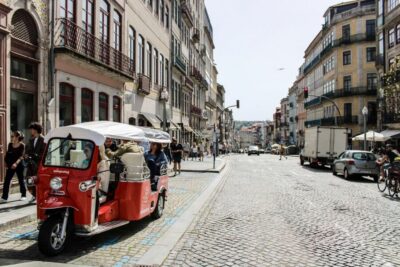
Guided Tour by Tuk-Tuk & Optional Douro River Cruise
Read our review →
Private Guided Tuk-Tuk Tour with Hotel Pickup
Read our review →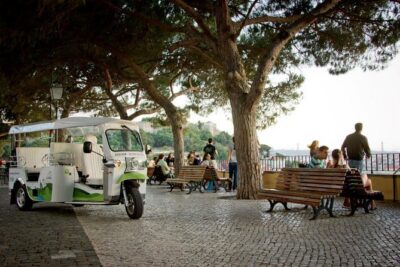
Private Lisbon Sightseeing Tuk-Tuk Tour: Alfama, Belém & More
Read our review →
Lisbon Highlights: Private Tuk Tuk Tour Adventure Sightseeing
Read our review →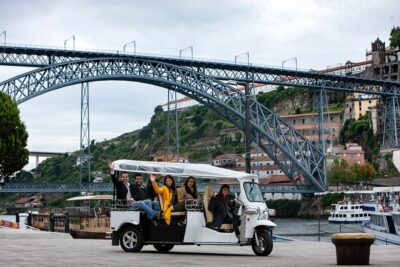
Discover Porto’s Highlights on a 2-Hour Private Electric Tuk Tuk
Read our review →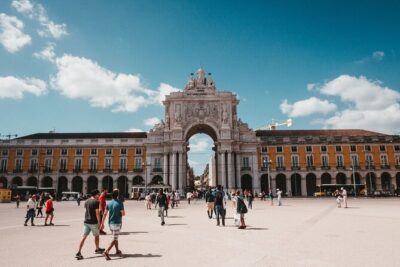
Welcome Lisbon Tour with Local Guide in Private Eco Tuk Tuk
Read our review →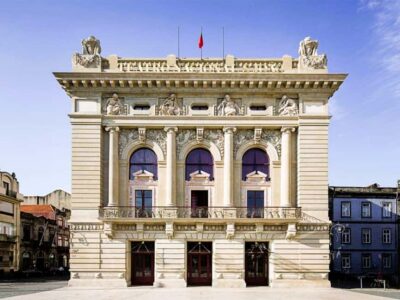
Browse the lists this tour appears in