
Reviewed · WALKING TOURS
Lisbon Essential Walking Tour: History, Stories and Lifestyle
Lisbon starts making sense after one good walk. This 3-hour Lisbon essential history loop links hilltop viewpoints, church art, and major moments in Portuguese politics to real street corners. I love that it is practical, not just sightseeing, and that the tour ends with you oriented for the rest of your trip.
Two things stand out for me: you get a guided route that hits iconic areas like Bairro Alto and Alfama, and you also get a included coffee and pastry break plus a tram ride. One consideration, though, is that Lisbon hills add up, so bring comfortable shoes and plan on a fair amount of stair and slope walking.
This is also a small-group experience, capped at 15 travelers, with a professional guide and a mobile ticket. If you want a fast, story-led start in the city, this is a solid way to get your bearings without feeling lost.
In This Review
- Key things that make this Lisbon walk worth your time
- Getting oriented fast in Bairro Alto and the hilltop neighborhoods
- Miradouro São Pedro de Alcântara: the Baixa and Tagus in one glance
- Igreja de São Roque: Jesuit building outside, museum-like interior inside
- Igreja do Carmo and the Carnation Revolution connection
- Santa Justa elevator: the best viewpoint stop that costs extra
- Coffee and pastry in Baixa, then a tram ride up the hill
- Alfama and Portas do Sol: fado streets, saints festivals, and the river edge
- Ending at Lisbon Cathedral: from Moor-era conquest to layered architecture
- Price and value: why $30.25 can feel fair here
- What you will actually do on the day, step by step
- Tips for getting the most out of it
- Who should book this Lisbon Essential Walking Tour
- Should you book this tour?
- FAQ
- How long is the Lisbon Essential Walking Tour?
- What is the price per person?
- Is the tour offered in English?
- What is included in the tour price?
- What is not included?
- How large is the group?
- Is there a mobile ticket?
- Where does the tour start and end?
- Can I get a full refund if I cancel?
- Is the tour suitable for most travelers, and are service animals allowed?
Key things that make this Lisbon walk worth your time
- Bairro Alto to Alfama in one flow: you move through Lisbon the way the city actually feels, down hills and into tighter streets.
- Viewpoints built for photos: São Pedro de Alcântara gives you sweeping views over the Baixa and the Tagus river.
- Churches that act like history textbooks: Jesuit and Gothic landmarks show Lisbon’s changing styles and power.
- Revolution stop you can stand inside: the Carmo site connects directly to the Carnation Revolution of 1974.
- A real local break: included coffee and a pastry in a neighborhood cafe, not a generic tourist stop.
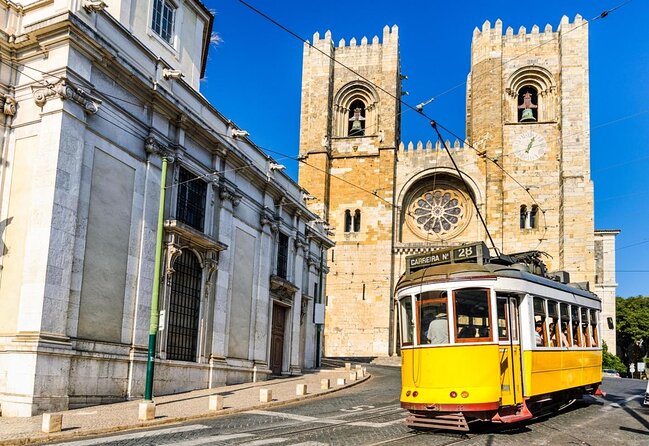
- Tram and classic neighborhoods combo: you ride a tram and then continue through downtown and into Alfama.
Getting oriented fast in Bairro Alto and the hilltop neighborhoods
Your tour begins in Bairro Alto, one of Lisbon’s most dramatic hill zones, where the streets rise and fall like they were drawn with a ruler that kept slipping. This area is tied to the city’s evolution over centuries, and your guide uses that big-picture story to help you understand why Lisbon looks the way it does: layers of rebuilding, changing fortunes, and neighborhoods that grew around views, access, and power.
A key early moment is the 1755 earthquake context. Lisbon is famous for being rebuilt after major damage, and the guide connects that to why people shifted around the city afterward. You do not just stare at buildings, you learn how a specific disaster helped shape where daily life landed next.
Then the walk naturally turns toward a viewpoint. Lisbon works best when you take a breath, look out, and then walk with purpose. That is exactly the rhythm here.
Practical note: this is a walking tour with a lot of elevation. If you are the kind of person who hates uphill stretches, you might want to pace yourself early, because the city keeps going that direction for hours.
More Walking Tours in Lisbon
- Lisbon: History, Stories and Lifestyle Walking Tour
★ 4.8 · 10,902 reviews - Best of Lisbon Small-Group Guided Walking Tour
★ 5.0 · 4,869 reviews - Lisbon: Food and Wine Small Group Walking Tour
★ 4.9 · 4,082 reviews
Miradouro São Pedro de Alcântara: the Baixa and Tagus in one glance
After Bairro Alto, you pass through the gardens of São Pedro de Alcântara. It is a welcome reset, greenery first, then the payoff. From here, you get big views over the Baixa and toward the south bank of the Tagus river.
Why this stop matters: Lisbon’s hills can make directions feel random until you see the city from above. When you finally recognize where the river sits relative to the main downtown, it becomes easier to plan later days. Even if you only remember one view from the tour, this is a strong candidate because it gives the city’s layout in one shot.
Take a few minutes. This is not a rush-through viewpoint. You want time to look, ask questions, and decide how you want to explore later without getting disoriented.
Igreja de São Roque: Jesuit building outside, museum-like interior inside
Next comes Igreja de São Roque, the church and museum of San Roque, closely tied to the Jesuits. The exterior can look austere at first glance, but the interior shifts your mood fast. This is where Lisbon’s artistic side shows up, with gilding, azulejo tiles, and paintings that give you a sense of the Baroque and Mannerist styles.
What I like about this stop is how the guide frames it. You are not just looking at decoration. You are seeing how religious institutions used art, architecture, and display to communicate ideas, status, and influence. The result feels less like random sightseeing and more like learning how Lisbon’s culture worked.
If you care about art and religious architecture, this is a highlight. If you do not, it still works because it gives you a clear contrast between the plain church façade outside and the rich visual world inside.
Time on the site is usually not long, so keep your expectations realistic. You are there to get the main story and see the key features, not to do a full museum day.
Igreja do Carmo and the Carnation Revolution connection
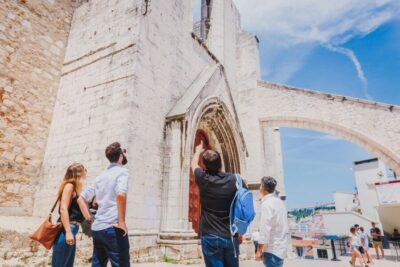
Heading downhill, you reach Igreja do Carmo, tied to the Carmo convent and church. Here, you get some of Lisbon’s Gothic architecture flavor, and the stop carries a very specific historical weight.
This is the kind of site that changes how you read street-level Lisbon. The reason is straightforward: it was at this location that the Carnation Revolution began in 1974, helping end nearly five decades of dictatorship. That means you are standing in a place tied to modern political history, not only medieval or older eras.
Why that is valuable on a first visit: Lisbon can feel like a timeline of art and emperors. This stop adds a recent chapter. It helps you understand why Portugal’s identity is not stuck in the distant past.
One practical tip for this portion: keep an eye on your footing. Old stone and uneven surfaces are part of the experience. If you are with family members or anyone who moves slowly, this is where the group tends to feel the walking more.
Other Lisbon plans worth comparing
- Best of Lisbon Walking Tour: Rossio, Chiado & Alfama
★ 4.9 · 2,700 reviews - Age of Discoveries Walking Tour in Belém
★ 5.0 · 1,513 reviews - Sintra & Cascais Day Tour with Pena Palace Entry and Gardens Walk
★ 5.0 · 962 reviews - Lisbon Roots – Small group Food & Culture Walking Tour w/tastings
★ 5.0 · 910 reviews
Santa Justa elevator: the best viewpoint stop that costs extra
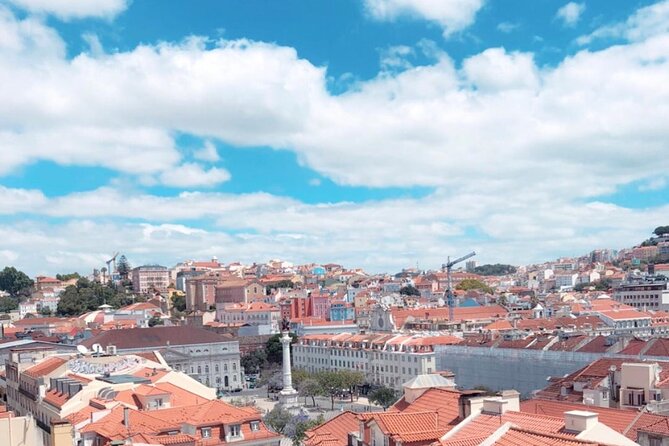
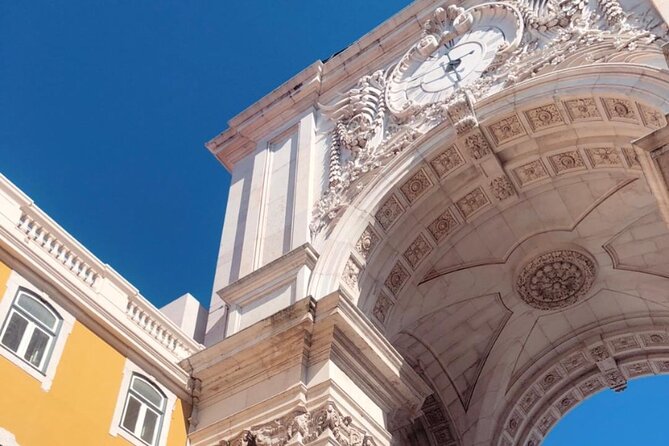
At Elevador de Santa Justa, you arrive at a dramatic structure in the Gothic Revival style. It is famous for giving some of the best viewpoints in the city.
Here is the simple value point: the tour includes the stop, but the elevator itself is not included. So you get the chance to see and orient, and then you decide if you want the ride ticket.
If you love views and have energy left, it can be worth it. If you are already view’d out, you can treat this like a satisfying exterior stop and keep your stamina for the rest of the walk.
Either way, the elevator stop fits well in the route because you end up with multiple perspectives, each tied to a different part of Lisbon’s story.
Coffee and pastry in Baixa, then a tram ride up the hill
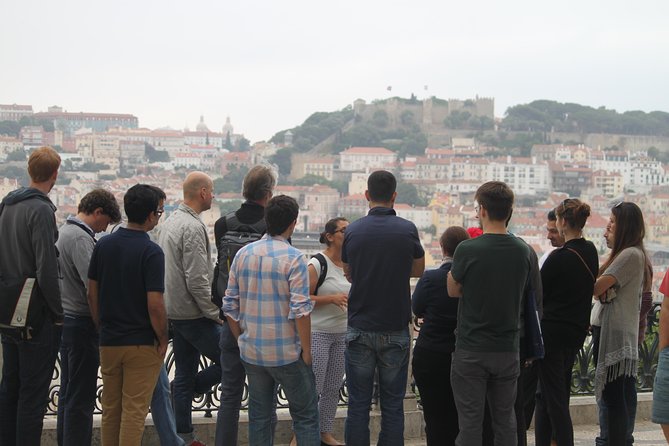
Now the route settles into Baixa de Lisboa, the central downtown zone. You take a short break with coffee and cake or pastry at a local café. This is one of those small inclusions that makes a walking tour feel human. Walking for hours turns every stop into a workout, and having an actual snack built in helps you keep pace without hunting for food on your own.
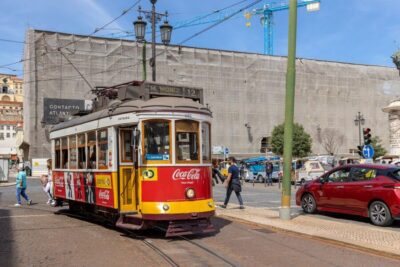
After the break, you head to Praca da Figueira and spend time seeing the downtown attractions. Then the tour does something smart for first-timers: you take a ride on a tram that connects the flatter city feel with the uphill neighborhoods.
You even get a ride up from the castle area toward Portas do Sol. That is a great move because it saves your legs during the moments where Lisbon’s slopes would otherwise chew up time and energy.
If you have never ridden Lisbon trams before, this is one of the easiest ways to experience the city’s street character without feeling like you are fumbling the system.
Alfama and Portas do Sol: fado streets, saints festivals, and the river edge
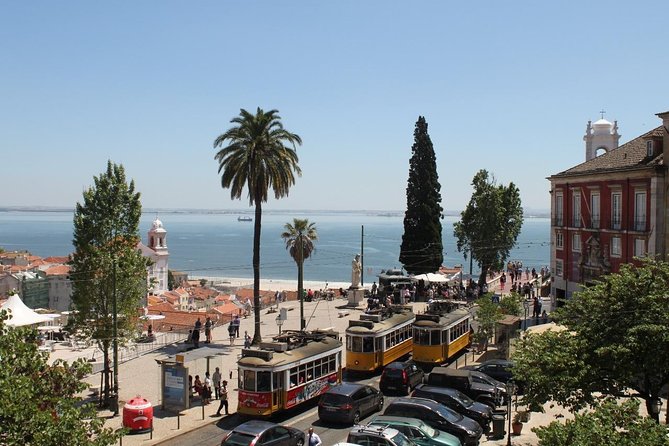
From Portas do Sol, the tour turns toward Alfama, one of Lisbon’s oldest traditional neighborhoods. This is where the streets get narrower, the atmosphere gets more lived-in, and the city starts to feel like a place rather than a postcard.
Along this portion you pass by key landmarks tied to Lisbon’s identity. You will see the Monastery of São Vicente de Fora and the National Pantheon, plus the big Alfama area stretching toward the Tagus river.
Alfama also connects directly to fado culture. If you want to understand why fado feels like it belongs here, this is where it starts to click. You also hear about the neighborhood’s saints festivals, especially St. Anthony, which gives you a clue about how local tradition still shapes everyday life.
You do not get a huge, long Alfama immersion. The tour gives you a taste with guided context so you know what you are looking at when you return later on your own.
Practical reality check: Alfama streets can be crowded, and the walking is slower. Dress and footwear matter here more than you think.
Ending at Lisbon Cathedral: from Moor-era conquest to layered architecture
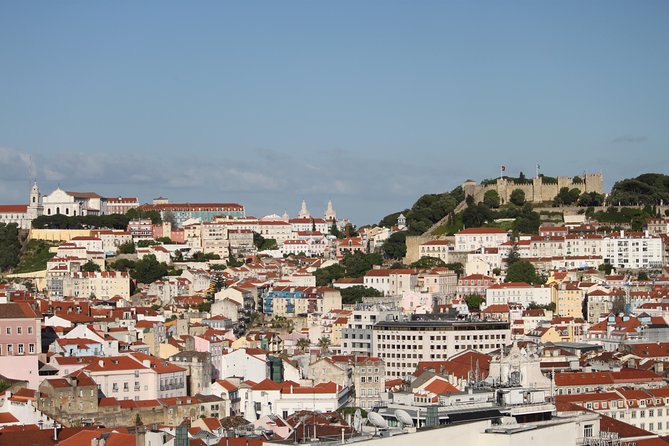
The tour ends at Lisbon Cathedral, built in 1150, about three years after the city was taken back from the Moors. That one fact alone explains why the cathedral matters. It sits at a turning point in Lisbon’s story, and it also shows how the city kept changing its style over time.
You finish with a site that reflects multiple architectural eras. Your guide connects those alterations to the broader idea of Lisbon as a city that rebuilds and remakes itself, not a frozen museum.
Why this works as a closing stop: it gives you a strong final anchor. If you start at a viewpoint and move through neighborhoods and churches, ending at a major cathedral helps your brain place everything into one coherent timeline.
If you want to continue exploring afterward, you will likely feel more confident about heading into nearby streets because you have both geographic and historical context.
Price and value: why $30.25 can feel fair here
At $30.25 per person for about three hours, this sits in a reasonable “starter tour” category. The best part is what you get for that money.
You are not only paying for a walking guide. You also get:
- a tram trip included
- an included coffee and pastry break
- a small-group format, with a maximum of 15 travelers
- liability and personal accident insurance
That combo matters. A walking tour without food is just endurance. A walking tour without transit support is just frustration. Here, the route mixes walking with a tram ride and a real break, so the time feels more balanced.
One extra cost to plan for: the Santa Justa elevator ticket is not included. If you know you want the ride, budget for it. If you are deciding on the day, the tour still sets you up by showing you what the viewpoint offers.
Also, one practical planning detail: the experience is commonly booked about 29 days in advance, so if you travel during busy seasons, reserving earlier helps you get a time that fits your schedule.
What you will actually do on the day, step by step
If you picture your day as a smooth arc, this tour is built to do that. You start in Bairro Alto, you move outward to viewpoints, you step inside major churches and their art, you head downhill into Carmo, you pause at Santa Justa, you regroup in Baixa for coffee, you take a tram ride, and you end in Alfama near the river, closing at the cathedral.
This pacing is a big reason it works for first-timers. It prevents the usual problem of “too many stops, no rhythm.” You keep getting a mix of:
- looking (viewpoints and exterior architecture)
- understanding (historical context explained by your guide)
- refueling (coffee and pastry)
- repositioning (tram ride when the hills get too much)
Tips for getting the most out of it
Here are the practical things that will make your tour better.
Wear comfortable shoes. This is not a flat walk. Old streets and slopes are part of the deal.
Bring water. Even if you get a coffee break, you still need hydration in Lisbon’s warm days.
If you want photos, come prepared to pause. Viewpoints like São Pedro de Alcântara and the Santa Justa area are where pictures happen, and you will want a minute instead of snapping while walking.
If you care about culture and politics, pay attention at the Carmo stop. It is the moment where the tour goes beyond old buildings and connects Lisbon to a modern turning point.
Finally, after the tour ends at Lisbon Cathedral, you are in a great spot to keep exploring. Use the orientation you gained to pick your next neighborhood instead of wandering without a plan.
Who should book this Lisbon Essential Walking Tour
This tour fits best if:
- you want a first-day introduction that covers key neighborhoods without you needing to map every step
- you like history that connects to what you are seeing on the street
- you want a guided route that reduces decision fatigue
- you enjoy church architecture and art, but also want modern context like 1974
- you appreciate small-group attention, with a maximum of 15 travelers
It might feel like too much if:
- you have limited mobility or you avoid uneven surfaces and slopes
- you want a fully museum-style pace with lots of time inside each building
Should you book this tour?
Yes, if you want a fast, solid start in Lisbon. For around $30.25 and three hours of walking, you get a tight route through Bairro Alto, Baixa, Alfama, plus viewpoint stops, major churches, and an end point at Lisbon Cathedral. The included coffee and tram ride make the day feel practical, not just busy.
Book it especially if you are only in Lisbon briefly and you want to understand the city’s layers right away. If you know you will want the Santa Justa elevator viewpoint ride, factor in the extra ticket cost and you will feel prepared.
If you want, tell me your travel dates and what you care about most, history, viewpoints, food, fado, or churches, and I can suggest the best order for your next 1 or 2 days in Lisbon.
FAQ
How long is the Lisbon Essential Walking Tour?
It runs for about 3 hours.
What is the price per person?
The price is $30.25 per person.
Is the tour offered in English?
Yes, it is offered in English.
What is included in the tour price?
A professional guide, a tram trip, a coffee and cake break, and liability and personal accident insurance are included.
What is not included?
Other food and beverages are not included, and the Santa Justa elevator ticket is not included.
How large is the group?
The tour has a maximum of 15 travelers.
Is there a mobile ticket?
Yes, you receive a mobile ticket.
Where does the tour start and end?
It starts in Lisbon, Portugal and ends at Lisbon Cathedral in Lisbon.
Can I get a full refund if I cancel?
Yes. You can cancel up to 24 hours in advance for a full refund.
Is the tour suitable for most travelers, and are service animals allowed?
Most travelers can participate, and service animals are allowed.
More Historical Tours in Lisbon
- Lisbon: Daytime or Sunset Boat Cruise with History and Wine
★ 5.0 · 1,053 reviews - Explore Lisbon by Tuk Tuk: History and Viewpoints
★ 5.0 · 840 reviews - Private Tuk Tuk Tour Through Lisbon’s Historical Streets
★ 5.0 · 734 reviews - Lisbon Sunset Sailing with Portuguese Wine and History
★ 5.0 · 668 reviews
Just added around Lisbon
- Morning Sailing Tour in Tagus River from Lisbon★ 5.0 · 68 reviews
- Private Half Day – The Majestic Pena Palace & Sintra★ 5.0 · 90 reviews
- Lisbon Private 3 hours tour★ 4.5 · 33 reviews
- PRIVATE Unforgettable Full Day Tour to Sintra from Lisbon★ 5.0 · 236 reviews
- Lisbon: Catamaran Luxury Sunset and Wine Tour★ 5.0 · 119 reviews
- Lisbon’s authentic Food and Wine tour with a Winemaker★ 5.0 · 67 reviews
- Sesimbra Wild Beach Tour from Lisbon★ 5.0 · 57 reviews
- Private Jeep Tour from Lisbon – Arrábida, Sesimbra & Beach Picnic★ 5.0 · 48 reviews
Walking Tours, compared.
Best of Lisbon Small-Group Guided Walking Tour
Read our review →
Porto Walking Tour, Lello Bookshop, River Cruise and Cable Car
Read our review →
Best of Lisbon Walking Tour: Rossio, Chiado & Alfama
Read our review →
Experience Porto’s Charm: 3-Hour Guided Walking Tour
Read our review →
Enjoy a Guided Levada Walk in the Rabaçal Valley
Read our review →Browse the lists this tour appears in