
Reviewed · WALKING TOURS
Lisbon Walking Tour – The Perfect Introduction to the City
Lisbon rewards the curious walker, and this route is a great way to start. I like how it gives you a down-to-earth orientation to downtown Lisbon in about 2.5 hours, and I especially like the way the tour ties major sights to big turning points in Portuguese history. You also get a short list of practical angles, like where to stand for views and what to notice as you move through the streets.
There is one drawback to keep in mind: this is a walk and a story marathon, so if you prefer slower pacing, pay attention early and ask questions. Also, the tour is tip-based at the end, so if you dislike that setup, decide your comfort level before you go.
In This Review
- Key highlights that make this tour a smart first move
- Why this Lisbon walking tour feels like the perfect intro
- Praça do Comércio start: the easiest way to get oriented fast
- The core storyline: 1755 earthquake Lisbon, told street by street
- Stop-by-stop: what you will see and why it matters
- Statue of D. José I and Praça do Comércio (Stops 1 and 2)
- Municipal Square (Stop 3)
- Santa Justa Elevator area (Stop 4)
- Praça Dom Pedro IV and Rua Augusta (Stops 5 and 6)
- Memorial for the 1506 Jewish Massacre (Stop 7)
- Igreja de São Domingos (Stop 8)
- Avenida da Liberdade and Casa do Alentejo (Stops 9 and 10)
- Largo do Carmo and the Carnation Revolution (Stop 11)
- Estação do Rossio and Igreja de São Roque (Stops 12 and 13)
- Praça Luís de Camões (Stop 14) and Bairro Alto (Stop 15)
- Guides, pace, and that end-of-tour tip decision
- Price value: why the low ticket works in your favor
- What to wear and bring, especially if it rains
- Who this tour suits best
- Should you book this Lisbon Walking Tour?
- FAQ
- How long is the Lisbon Walking Tour?
- What is the price, and is there any additional cost?
- Is the tour offered in English?
- Where do we meet the guide?
- Where does the tour end?
- How many people are in the group?
- What major landmarks and history does the route include?
- Does the tour run in the rain?
- Are service animals allowed?
- Can I get a full refund if I cancel?
Key highlights that make this tour a smart first move
- First-day Lisbon in 15 stops, focused on Baixa and Chiado with an ending near Praça Luís de Camões
- Major landmarks on the route, including Santa Justa Elevator and the Carmo area tied to the Carnation Revolution
- History you can see, with the 1755 earthquake theme and churches that survived it
- Small group feel, with a maximum of 20 travelers
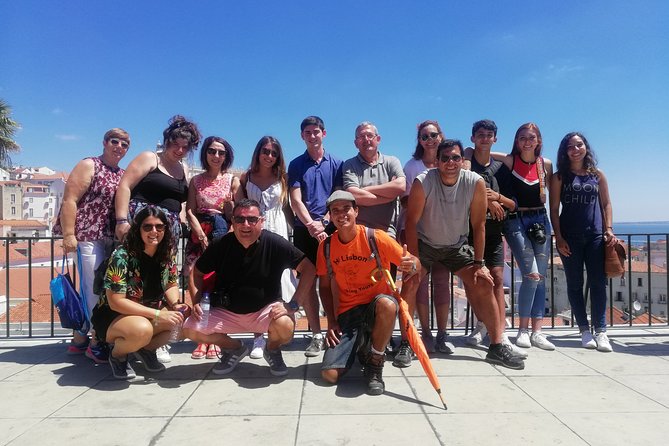
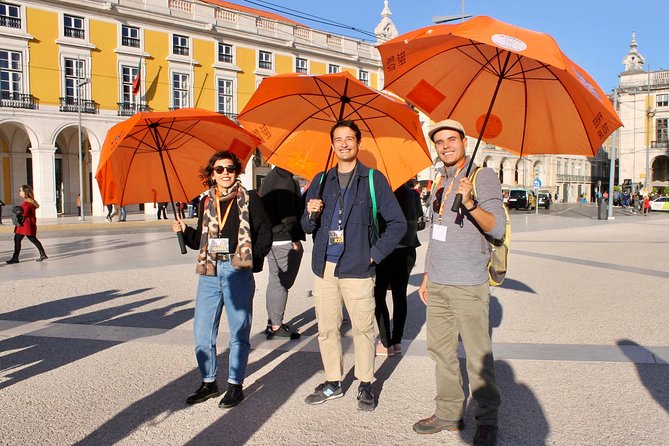
- Find-your-guide ease, look for the guide with an orange umbrella at Praça do Comércio
- English-language tour with a mobile ticket for check-in
Why this Lisbon walking tour feels like the perfect intro
If Lisbon is new to you, you need two things fast: a mental map and a reason to care about what you are seeing. This tour does both, moving through classic downtown streets and squares, then connecting the dots to the 1755 Great Lisbon Earthquake and the later Carnation Revolution.
I like the focus on the city center. Instead of sending you all over town, you learn the logic of the streets that most first-timers will bounce between for days afterward. And because it is a walking format, the history sticks. You do not just hear about a place, you arrive at it, look around, and understand why that exact spot matters.
One more thing, the format makes the price feel almost unfair. The ticket shows a very low stated cost, and then the real “payment moment” is at the end, where you pay your guide what you see fit. That means your total spend is largely under your control, as long as you like the storytelling and the pacing.
More Walking Tours in Lisbon
- Lisbon: History, Stories and Lifestyle Walking Tour
★ 4.8 · 10,902 reviews - Best of Lisbon Small-Group Guided Walking Tour
★ 5.0 · 4,869 reviews - Lisbon: Food and Wine Small Group Walking Tour
★ 4.9 · 4,082 reviews
Praça do Comércio start: the easiest way to get oriented fast
The meeting point is Praça do Comércio, right at the start of Lisbon’s downtown core. This is a smart place to begin because it is open, landmark-heavy, and it helps you orient to the rest of the walk. You meet at Praça do Comércio, and the guide should be easy to spot with an orange umbrella.
From there, the tour moves quickly into the “Lisbon you actually walk through” zone: Baixa streets, squares, and the connective tissue between major sights. The entire experience is about 2 hours 30 minutes, so it is long enough to feel like a real city introduction, but short enough that you still have energy left for lunch, an elevator ride, or a sunset plan.
Expect steady walking. One helpful detail: this kind of route has worked for families with strollers, which tells me the streets and pacing are generally manageable.
The core storyline: 1755 earthquake Lisbon, told street by street
Lisbon has layers, and this route uses them. The big theme is the Great Lisbon Earthquake of 1755, and the tour brings it to life by pointing out churches and sites tied to what was damaged, what survived, and how the city rebuilt.
You get the earthquake story not as a detached lecture, but as a set of clues. You will see religious buildings tied to survival and loss, then shift to political history later at Largo do Carmo. By the time you reach Rossio and the Chiado side of the center, you are not just naming landmarks. You understand what kind of city Lisbon became after the quake.
The payoff is practical. Once you know why certain buildings survived, you start noticing details on your own later, like which parts look older, what was rebuilt, and what the city chose to emphasize as it changed.
Stop-by-stop: what you will see and why it matters
Below is what the walk feels like, stop after stop, and what to look for so you are not just moving your feet.
Other Lisbon plans worth comparing
- Best of Lisbon Walking Tour: Rossio, Chiado & Alfama
★ 4.9 · 2,700 reviews - Age of Discoveries Walking Tour in Belém
★ 5.0 · 1,513 reviews - Sintra & Cascais Day Tour with Pena Palace Entry and Gardens Walk
★ 5.0 · 962 reviews - Lisbon Roots – Small group Food & Culture Walking Tour w/tastings
★ 5.0 · 910 reviews
Statue of D. José I and Praça do Comércio (Stops 1 and 2)
You start at the Statue of D. José I area and then transition into Praça do Comércio. This big square works as an orientation hub because it anchors you to central Lisbon right away. The scale of the place also helps you understand why the downtown area became the focus for major public life.
At this point, I treat it like a warm-up: look for the views and the street directions, then let the guide’s story connect the square to the bigger Lisbon picture. If you come in tired, this is where you get your bearings.
Municipal Square (Stop 3)
Next is the Municipal Square area, where city administration sits. Even if you are not obsessed with local government, this is a useful stop because it signals where civic Lisbon concentrates. It helps you understand the city’s “center of gravity,” which makes the rest of the route feel less random.
Santa Justa Elevator area (Stop 4)
Then comes one of Lisbon’s famous vertical icons, the Elevador de Santa Justa area. This is a perfect mid-tour landmark because it gives you a visual break from street-level walking and gives you a clear “photo and perspective” moment.
Even if you do not ride it that day, you still benefit. You will remember where it is when you plan a later viewpoint. The elevator also helps you appreciate Lisbon’s mix of old street texture and later engineering ambition.
Praça Dom Pedro IV and Rua Augusta (Stops 5 and 6)
Praça Dom Pedro IV is one of the older, defining squares in the city. From there, you walk into Rua Augusta, a main street that is basically the downtown spine.
Rua Augusta is the part of Lisbon that feels designed for flow, crowds, and energy. The guide helps you see past just the storefronts and people-watching. You start recognizing the patterns: where the main circulation runs, how the streets funnel you toward bigger squares, and where side streets branch off into neighborhoods you might want later.
If you like efficient sightseeing, this section is a win. It is classic Lisbon downtown with just enough structure that you do not feel lost.
Memorial for the 1506 Jewish Massacre (Stop 7)
A quieter stop follows: the memorial honoring victims of the Jewish massacre in 1506. This is important because it adds a human and historical layer that many casual downtown walks skip.
When this kind of moment hits, I find the best approach is to slow down, read, and let the meaning settle. It changes your whole understanding of the city center. Lisbon is not only postcard architecture, it is also memory and loss.
Igreja de São Domingos (Stop 8)
After the memorial, the tour moves to one of the big churches in the downtown core. Igreja De S Domingos is one of those places that makes you look up even if you did not plan to.
This stop works especially well with the earthquake theme. A church like this becomes a visible timeline: it reflects what was valued, damaged, and rebuilt. Even if you are not a church person, you will usually notice the scale and the dramatic presence.
Avenida da Liberdade and Casa do Alentejo (Stops 9 and 10)
Then the tour steps into Avenida da Liberdade territory, Lisbon’s more elegant avenue. It is a change of rhythm. Instead of tight medieval street energy, you get a broader sense of Lisbon’s “grand” side.
Right after that, Casa do Alentejo appears as a charming stop that adds a local, human-scale feel. It helps you connect the ceremonial streets with places where people actually gather, eat, and live daily life.
Largo do Carmo and the Carnation Revolution (Stop 11)
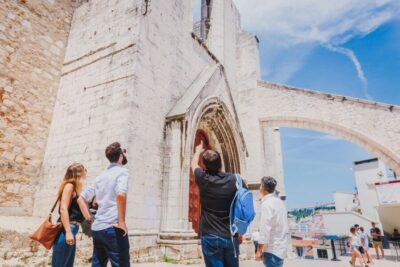
Largo do Carmo is tied to the Carnation Revolution, which is exactly the kind of historical contrast you want mid-tour. The mood shifts from earthquake survival and reconstruction to political change and modern Portuguese identity.
If you are the type who likes to understand Lisbon as a living country, this is a highlight. It turns the city center into a timeline you can walk through.
Estação do Rossio and Igreja de São Roque (Stops 12 and 13)
Next comes Estação do Rossio, the old central station in Lisbon. Stations are more than transport. They are where people flow, where schedules shape life, and where tourists eventually end up.
This matters because Rossio becomes your practical anchor later. It is often where you will pass through on your own plans. Knowing it early saves you time on day 2.
Then you reach Igreja de São Roque, and here the 1755 earthquake theme becomes very concrete. One of the key points is that this church is among those that survived the earthquake. That survival detail gives you a reason to pay attention beyond aesthetics.
Praça Luís de Camões (Stop 14) and Bairro Alto (Stop 15)
The tour ends near Praça Luís de Camões, one of Lisbon’s iconic squares. From there, the walk stretches toward Bairro Alto, the nightlife area.
This final stretch is useful because it helps you decide what you want next. If you want nightlife, you now know where to head. If you want a calmer evening, you can use the location to plan a different direction. Either way, you finish with a “what to do tonight” compass.
Guides, pace, and that end-of-tour tip decision
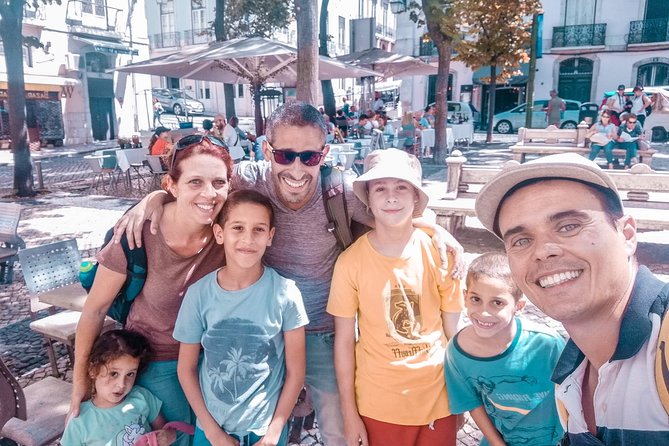
The tour is designed to be flexible. The stated idea is that you pay your guide whatever you see fit at the end. That is a great model if you feel the guide earned it.
Most guides in this format are praised for storytelling energy and for bringing history to life, including the earthquake explanation and the political history at Largo do Carmo. Names that show up in guest experiences include Tiago, Natalia, Jose, Walter, Kate, and Jose Tenorio, with a common thread of clear enthusiasm and practical guidance.
Still, there are two considerations you should be honest about:
- Pace can vary. Some people found the guide spoke quickly and wanted more time to catch details.
- The start of the tour can include a short explanation about tipping. If you get uncomfortable when expectations are stated strongly, go in knowing that this tour is tip-based, even if the guide keeps it respectful.
My advice is simple. Bring cash or a way to pay a tip if that is what you want to do. If you struggle with fast speech, choose a spot where you can clearly hear the guide, and ask a question early, not after you have already missed the key point.
Price value: why the low ticket works in your favor
The tour lists a very low price per person, and that makes it an easy first-day commitment. But the bigger value is what you get for that money: you receive a downtown route that sets you up to explore for the next several days without guessing.
Think of it like this. Even if you only use the tour to learn where Santa Justa is, where Rua Augusta starts to matter, where Rossio anchors your plans, and where the Carnation Revolution story lands, you have already earned back your time.
Because it is guided, you also avoid the common tourist mistake of reading about Lisbon afterward but missing the visible connections while you are standing in the streets. A good guide turns random landmarks into a coherent city.
What to wear and bring, especially if it rains
Lisbon weather can be unpredictable, and this tour generally keeps going even in rain. One practical takeaway: bring something for wet weather. A rain poncho and a small umbrella help, because the route is outdoors most of the time.
Wear comfortable shoes. The walk covers a lot of ground and involves frequent stops, which is great for sightseeing but harder if your shoes are not up to it. If you are bringing a stroller, this tour format has worked for families before, but you will still want to keep an eye on uneven surfaces and crowd moments near big squares.
Who this tour suits best
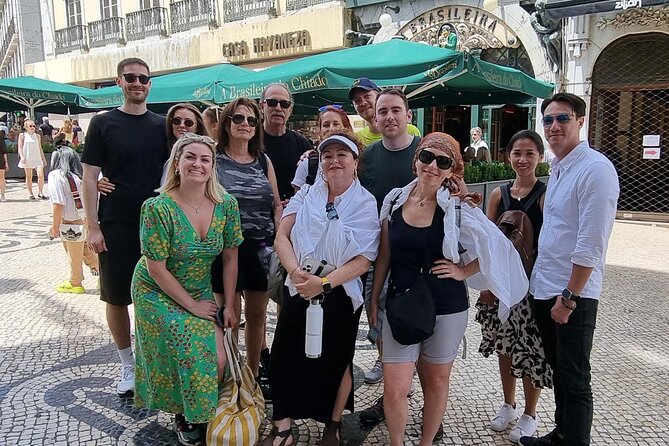
This is ideal if:
- You are visiting Lisbon for the first time and want a fast orientation to Baixa and Chiado
- You like history that connects to real places, especially the 1755 earthquake story
- You want a guided route that ends near a central square, so your next plan is easy
It may be less ideal if:
- You hate walking tours and prefer museums or indoor stops only
- You need a slow pace and detailed explanations at a measured speed
If you fall in the middle, it is still a strong choice. You can always use the end of the tour to slow down on your own and pick specific places to return to.
Should you book this Lisbon Walking Tour?
I would book it if you want a smart first move. The route hits the big downtown landmarks, connects them to key historical moments like the 1755 earthquake and the Carnation Revolution, and ends in a location that makes it easy to keep exploring.
If you do book it, make one small plan for yourself: bring a question or two, and decide up front how you want to handle tips at the end. Then the experience becomes what it is meant to be, a guided introduction that makes Lisbon easier to enjoy on day 1 and day 2.
FAQ
How long is the Lisbon Walking Tour?
It runs for about 2 hours 30 minutes.
What is the price, and is there any additional cost?
The price is listed as $1.25 per person. The tour also includes a pay-your-guide-at-the-end approach, where you pay whatever you see fit.
Is the tour offered in English?
Yes, the tour is offered in English.
Where do we meet the guide?
You meet at Praça do Comércio, and you should look for the guide with an orange umbrella between the big arch and the statue in the middle.
Where does the tour end?
The tour ends around Praça Luís de Camões, at Largo Luís de Camões.
How many people are in the group?
There is a maximum of 20 travelers.
What major landmarks and history does the route include?
The highlights include the Santa Justa Elevator area, Carmo Church ruins in the Carmo area, and the Great Lisbon Earthquake of 1755, plus the Carnation Revolution connection at Largo do Carmo.
Does the tour run in the rain?
The tour is designed to go on even in rain, so bringing rain protection like a poncho or umbrella is a good idea.
Are service animals allowed?
Yes, service animals are allowed.
Can I get a full refund if I cancel?
Yes. You can cancel up to 24 hours in advance for a full refund. If you cancel less than 24 hours before the start time, the amount paid is not refunded.
Just added around Lisbon
- Morning Sailing Tour in Tagus River from Lisbon★ 5.0 · 68 reviews
- Private Half Day – The Majestic Pena Palace & Sintra★ 5.0 · 90 reviews
- Lisbon Private 3 hours tour★ 4.5 · 33 reviews
- PRIVATE Unforgettable Full Day Tour to Sintra from Lisbon★ 5.0 · 236 reviews
- Lisbon: Catamaran Luxury Sunset and Wine Tour★ 5.0 · 119 reviews
- Lisbon’s authentic Food and Wine tour with a Winemaker★ 5.0 · 67 reviews
- Sesimbra Wild Beach Tour from Lisbon★ 5.0 · 57 reviews
- Private Jeep Tour from Lisbon – Arrábida, Sesimbra & Beach Picnic★ 5.0 · 48 reviews
Walking Tours, compared.

Best of Lisbon Small-Group Guided Walking Tour
Read our review →

Porto Walking Tour, Lello Bookshop, River Cruise and Cable Car
Read our review →
Best of Lisbon Walking Tour: Rossio, Chiado & Alfama
Read our review →
Experience Porto’s Charm: 3-Hour Guided Walking Tour
Read our review →
Enjoy a Guided Levada Walk in the Rabaçal Valley
Read our review →Browse the lists this tour appears in